Spring is often the time people want to get out and plant trees because everything is starting to green up after months of being dormant. However, fall is a better time to plant. When a tree is planted in the fall it allows the root system to establish during cooler weather before the summer heat and dry weather kicks in.
Trees provide many things to our landscapes which include shade, beauty, privacy, wildlife habitat, and a structure. Whatever your reason for planting a tree, consider the size of the space you are working with because tree size matters: bigger is not always better. One mistake often made is not accounting for the mature size of the tree planted. It’s an easy mistake to make; when the tree is purchased it may only be a few feet tall. A few short years later it may fit the landscape perfectly, but a few more years down the line it becomes an eye sore and takes away from everything else. Branches can be growing into the side of a house or walkway and roots can push up walkways and be a tripping hazard. Keep in mind that even small trees can function as shade trees, provide screening, and structure to our gardens. This article will highlight different small trees so you can optimize your small spaces.
Redbuds: A lot of breeding and selection has been done in the Eastern Redbud in recent years. Redbuds are an understory tree often seen on the edges of a forest. They grow well in part shade in moist well drained soils. This native does not tolerate drought conditions. This species is a great addition to support pollinators and song birds. There are many readily available cultivars of redbuds. One of my favorites, Appalachian Red has hot pink flowers while Tennessee Pink is more of a soft pink. There are weeping redbuds and redbuds that have uniquely colored foliage. Developed at NCSU, Cercis canadensis ‘Flame Thrower’, has newly emerged leaves that are purple. As the leaf matures it changes to red then to a reddish-bronze and ultimately maturing at a yellow or green.
Crabapples: The native Southern crabapple grows to about 20 to 30 feet tall and is an excellent food source for bees in the early spring. They do best in part shade and like well-drained, but moist soils. It may be beneficial to look for cultivars that are resistant to rusts, Fire Blights, and scabs. One of the best new disease-resistant crabapples is Malus ‘Sutyzam’. In the spring, blooms are fragrant and 1” wide and the fall leaf color is yellow to light red.
Maples: There are hundreds of cultivars of Japanese maples that mature into large shrubs or small trees. They come in a variety of colors with interesting leaf shapes and forms. There are weeping and upright varieties. Their growth is slow with most having deeply lobed leaves. To prevent sunburn, most cultivars need afternoon shade. For year round interest consider Acer palmatum dissectum ‘Ever Red’ or Acer palmatum ‘Sango Kaku’. ‘Ever Red’ has an elegant shape and even without leaves in the winter will be a focal point. New spring leaves resemble silver hairs and turn red as they mature. The red color is held throughout summer into fall. Spring leaves of Sango Kaku emerge a greenish-yellow, but turn an orange-red by summer. During the winter, young trees have a red bark for year round joy.
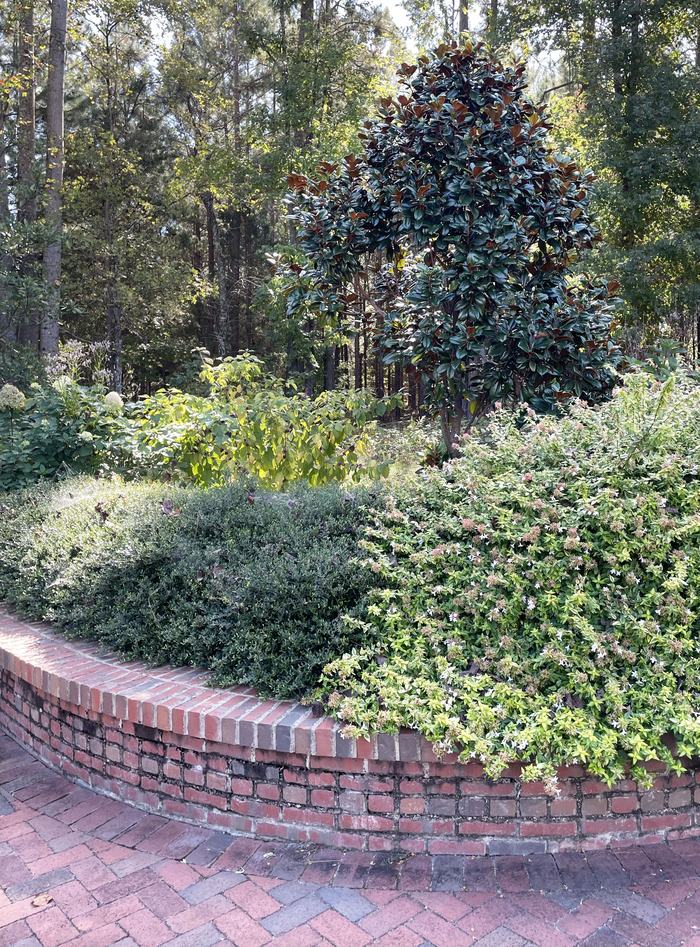
Magnolias: While the traditional Southern Magnolia (Magnolia grandiflora) can grow to immense heights, there are several smaller magnolias with compact growth habits. If you are looking for a smaller version of the Southern Magnolia, take a look at ‘Little Gem’ Dwarf Southern Magnolia or ‘Teddy Bear’ Southern Magnolia. If you like the saucer magnolias, consider Magnolia x soulangiana ‘Rustica Rubra’ or Magnolia ‘Genie.’