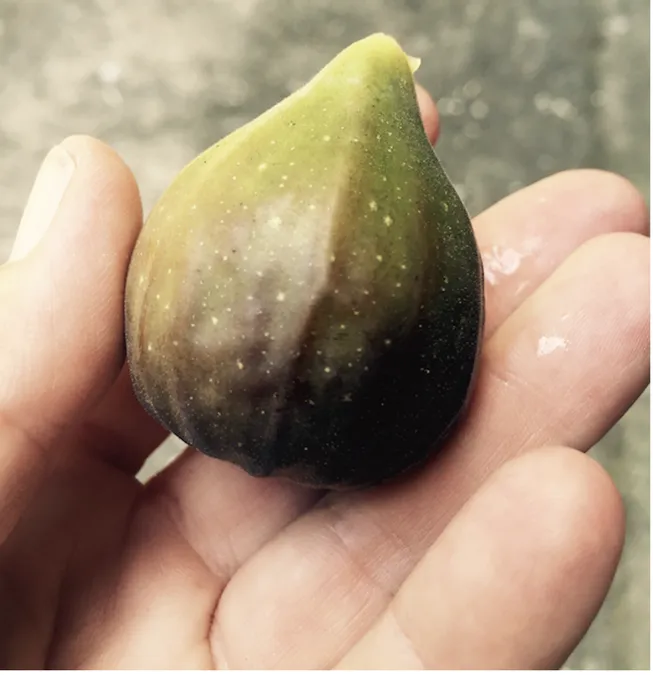
Why Figs?
As a horticulture agent with Cooperative Extension, I often hear from folks interested in growing their own fruit. Fruit such as peaches, cherries, or even cultivated blackberries, are quite difficult to grow, and I encourage people to buy those items from their local farm stands. Figs, on the other hand, are a fairly carefree fruit to grow. Figs are such a versatile fruit too – they can be eaten fresh, baked in cakes or bread, or used to create delicious preserves.
Planting Your Fig
If you’re considering growing your own fig trees, there are a few important considerations. Plant your fig tree in well-drained soil in full sun; amend your soil well with good compost at planting. Ideally, test your soil to see if lime is needed to raise the pH (Figs like a minimum 6.0 soil pH). Plant in the fall or early winter to help ensure good root establishment prior to the growing season. Consider the space needed for a mature fig: while the size can be controlled somewhat with pruning, they can get 15’-30’ in both height and spread. Branches tend to spread out at least as wide as tall.
Figs grown in Richmond County can occasionally get zapped by extreme cold temperatures in the winter or the spring freezes we sometimes experience. Even if the tree is killed down to the ground, it will usually come back from the roots and start over again. However, choosing a protective site can help reduce the risk of cold damage. Figs often perform best if situated on the south side of a structure, like a barn or outbuilding, which provides protection from cold winds, and ideally where it will not receive early morning sun or late evening sun in the winter (which can stimulate premature emergence from dormancy). If siting near a building, keep in mind that bees and wasps love the sugary figs, so avoid planting them in high traffic areas near a pathway or deck.
Figs benefit from light pruning to keep the tree at an appropriate size and shape, removing dead or crossing branches as needed. Good light penetration into the canopy is important. Remove suckers, and head back shoots by about 1/3 to stiffen them. Figs can be single trunk or multi-stem (if trees are killed back by a freeze, they will come back as a multi-stem). Prune in late winter, at least by the end of February.
Management
Fertilize fig trees throughout the growing season. According to Clemson University’s Fig factsheet, young plants up to a couple of years old should be fertilized monthly from April through July with 1/3 pound of 10-10-10; for larger, older trees, up to 4 pounds three times during the same period. If the tree is showing a lot of growth that needs heavy pruning, consider reducing the fertility the next year.
Figs are relatively problem free, however they are vulnerable to a few pests and diseases. Avoid planting if root-knot nematode is a known problem in the soil. Other diseases can include fig rust and fig mosaic. Ambrosia beetle can be an issue: I have seen ambrosia beetle attack figs pruned after February, as the insects are active beginning in March. The stress of pruning can attract the beetles. If infested, you’ll see toothpick-like extrusions of sawdust extending out of the trunk where they have bored. Other pests include spider mites, scale insects, leaf hoppers and Japanese beetles. Rarely do any of these pests reach high levels of severity, however. Animals attracted to the fruit is the biggest challenge: birds enjoy pecking at the ripe fruit, creating syrupy openings that attracts wasps, bees, and June bugs. Once fig trees are large, there’s usually enough fruit to go around.
Figs produce fruit in abundance, and often have an early and later fruit set; even if freeze damage destroys the first crop, often a second will do fine. Young trees require three or four years to develop a fruit crop. Fig varieties suited to the southeastern US are self-pollinating; flowers form inside a cavity, which then develops into the fruit. In California, a special wasp is required as a pollinator for varieties grown there.
Enjoying the Fruit
Cultivars recommended for our area include the old standbys ‘Brown Turkey’ and ‘Celeste’, as well as some less-well known varieties such as ‘Brunswick’, ‘Chicago Hardy’, and ‘Magnolia’. Fig trees are easily propagated through cuttings or layering, so if you know someone willing to share, you can grow your own fig trees!
Fun fact: did you know fig leaves are also considered a delicacy? Fig leaves are not eaten but used for the flavor, considered similar to vanilla and coconut; use as a wrapping when cooking fish or as flavor infusion for puddings, ice-cream and other desserts.
John's Farm, a You Pick Operation located in western Richmond County (find on Facebook), has a variety of figs which should be ready for harvest soon. Pick your own for making preserves or eating out of hand. Enjoy fabulous figs, while the season lasts!