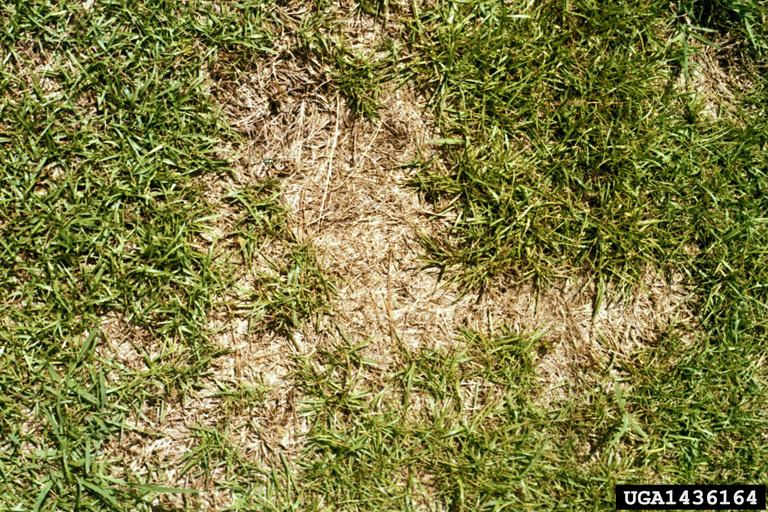
Centipedegrass is a warm season grass that is a commonly found in Sandhills lawns. It performs well here and is relatively low maintenance compared to other warm season grasses such as Bermuda, zoysia and St. Augustinegrass. However, many warm season grasses are damaged when we have a colder-than-normal winter. According to the North Carolina State University website, TurfFiles, centipedegrass and fine-textured zoysiagrass (such as Emerald, Zeon) get hit hard by winter’s cold, with coarse-textured zoysiagrass (e.g. Empire, El Toro) and Bermudagrass faring better.
What I explain to clients is that turf which is weak going into winter is more susceptible to winter damage than healthy turf. While centipedegrass is low maintenance, it is not “no maintenance”. Many homeowners do little liming or fertilization as part of regular lawn maintenance. While it is true that centipedegrass performs well at a lower soil pH (i.e., more acidic) than Bermudagrass, our native soil pH can be as low as 4.5. Centipede performs best at a pH of 5.5 to 6.0, so some liming is still needed. If soil pH is below or above the optimum range, plants are not able to take up fertilizer, even if it is applied. Another important aspect of our Sandhills soils is they are typically low in potassium, and centipedegrass requires a lot of potassium, or potash as it is frequently called. One of the more important benefits of potash is that it helps plants withstand cold temperatures. Potassium is one of the big 3: Nitrogen, Phosphorus, and Potassium, or NPK (these correspond to the number on a fertilizer bag, and is the percent of that nutrient in the bag by weight. For example, a bag of 5-5-15 is 5% N, 5% P, and 15% K, the K being potash). So centipedegrass is often potassium deficient, where lime and a high potassium fertilizer (such as 8-0-24) have not been applied appropriately.
Another contributing factor that may lead to winter kill is the timing of fertilizer application. Centipedegrass should be fertilized using a nitrogen fertilizer just once per year, in the first week or two of June. Excess nitrogen fertilizer, using more than half a pound of nitrogen per thousand square feet, during the year and especially after July, can lead to excess growth which is susceptible to cold temperatures. Herbicide applications, on the other hand, usually do not cause increased winter damage. However, another frequent homeowner practice is the use of a so-called “weed and feed”. This material is a two-in-one product, a preemergence herbicide combined with fertilizer. We’re all short on time, so it is tempting to use these products for efficiency. However, they are not recommended for centipedegrass, although you will often see the phrase “safe for centipedegrass” on the label. The problem stems from the fact that a preemergence herbicide should be used in the late winter/early spring, before warm season weeds begin to germinate. This is absolutely the wrong time to fertilize centipedegrass, and therefore this product is more of a detriment than a help to achieve a good lawn.
Finally, in addition to cultural practices which create weak turf susceptible to winter kill, microclimates can influence winter damage as well. Shade, soil compaction, and low areas that hold cold air, which flows like water downhill, can all contribute to susceptibility.
There’s no quick fix for winter kill, or just having weak turfgrass. The remedy is almost always the same: first, do a soil test (a free service by North Carolina Department of Agriculture and Consumer Services), follow the recommendations provided in your report, and finally adhere to the seasonal recommendations found in the Centipedegrass Maintenance Calendar, available at the Cooperative Extension office or online at TurfFiles. For those with a smart phone, there is a very good NC State Lawn Care app for free download. This app provides alerts of pest and disease problems, lawn maintenance guidelines, and more. If you are disappointed in your lawn’s performance, the N.C. Cooperative Extension, Richmond County Center has information to help get you on the right track. Contact Paige Burns Clark at the Richmond County Center, 910-997-8255 or lpburns@ncsu.edu.