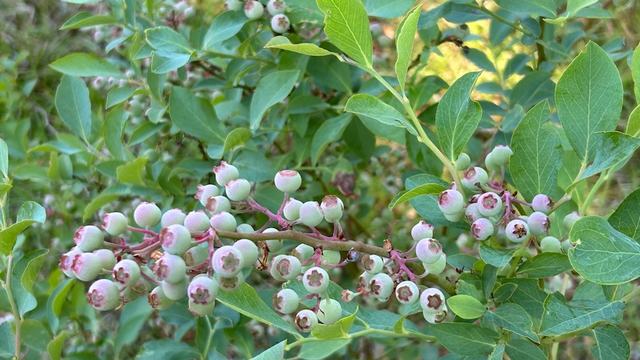
What could be better than strolling out to your yard to pick a cup of fresh blueberries for your morning cereal or blueberry pancakes? With a little effort, you can enjoy this small luxury during blueberry season! You don’t have to live on a farm or have an extensive yard to enjoy them: blueberry bushes are actually quite attractive in the landscape, with white or pink flowers in the spring and showy fall color. They work well as a hedge, artfully arranged in a large landscape bed, or singularly placed as a specimen plant. They are relatively pest free, so consider blueberries as a carefree addition to the landscape that gives back more than the average shrub. If you’ve been thinking about ways to start “growing your own” fruits and vegetables, blueberries are a great place to start!
A native plant
As a native plant (although what we purchase for fruit are selected varieties), blueberries are well adapted to our typical low soil pH. Before planting, soil test to be sure you are in the target 5-5.3 range. If your soil pH is higher, use wettable sulfur (90% S), to adjust. In a light, sandy soil use 1 pound (2.5 cups) per 100 square feet to lower pH by 1 unit (for example, from 6.0 to 5.0). On heavier soils such as clay, use 2 pounds per 100 square feet. It takes 3-4 months for the sulfur to take effect, so take that time into account as you’re planning. Blueberries require well drained soil and also benefit from the incorporation of a significant amount of organic matter into the planting area, such as old hay, rotten sawdust or fine pine bark mulch. Apply 3-4 inches of organic matter (don’t skimp here) to the planting area (ideally in a space 18-24” wide), and incorporate it well into the soil. The final planting area should be mounded at least 6 inches above the soil line. Irrigation and full sun will give best fruiting. In our region, the species rabbiteye and southern highbush perform best in our heat and drought-prone conditions (it is too hot here for highbush varieties to perform optimally). If planting rabbiteye, use at least three different varieties for cross-pollination. Climax, Premier, Tifblue and Powderblue are excellent varieties to consider. Southern highbush provides the earliest berries, as early as the end of May, as well as some of the best tasting; look for the varieties O’Neal and Legacy.
Getting established
The best time to plant blueberries in our region is late winter (February). Plant southern highbush with a spacing of 4-5’ between plants and the larger growing rabbiteye varieties 6’ apart. If planting one year old plants, a couple of years of careful management is in order to get the plants well established. Prune to just two or three of the most vigorous stems, then remove any existing flower buds on the stems to prevent flowering the first year. These last two directives are the hardest to follow – people want the joy of picking blueberries as soon as possible! However, the first priority should be to develop a vigorous plant, and allowing fruit production too early stunts plant growth. If planting a larger, older plant, remove crossing branches at the base as well as any weak shoots. Remove the flowers to help the plant get established.
Do not fertilize at planting time; once the plant has full sized leaves in the spring, apply 1 tablespoon of 12-12-12 or 10-10-10 around the root zone area (if a one year old plant), then repeat twice more at six week intervals. The following year double the amount of fertilizer used. By the third year, when plants can begin fruiting in earnest, scatter 1 cup of 10-10-10 in the dripline of the plant. If the soil report shows adequate phosphorous in the soil (which is often the case in our soils), use 8-0-24 fertilizer instead. Avoid the temptation to over fertilize: blueberries naturally grow in low nutrient soil, and roots can be damaged by over fertilization.
As plants mature, older canes will become less productive and should be removed. Mature canes are characterized by larger size (thicker), with a grayish bark, sometimes with mossy lichen on them. These canes should be removed in the late winter to make room for younger, more vigorous shoots. Rabbiteyes, which are especially vigorous plants, may require cutting back in height during the summer, after fruit is harvested, to reduce the size of the plant. This will make the fruit easier to pick the next year. NC State Extension has an excellent publication, “Growing Blueberries in the Home Garden”, available online, with more information.
As you enjoy fresh blueberries this summer, think about planting blueberry bushes of your own next February! Now is a great time to prepare: determine what varieties you really like, where to purchase plants, and prepare the site. If you have questions on any of these steps, contact us at your county Cooperative Extension office, 910-997-8255, or check out our website for other information.