Gardeners love To Do lists. There are a lot tasks to accomplish in the garden, and those lists help organize the work so it gets done in a timely fashion. Writers of gardening articles love to create To Do lists, as it provides a nice framework for organizing gardening information to share with readers.
This article is a Garden DON’T Do list.
Here we are in August, with fall just around the corner. As you plan your upcoming gardening activities, keep these DON’Ts in mind!
Don’t…fertilize your centipedegrass with a nitrogen fertilizer anymore this year. Many people around here have centipedegrass lawns, a warm season turfgrass. In the Triangle, Triad, and Charlotte area fescue, a cool season grass, is more common. If you listen to ads on some TV and radio stations, landscape companies and lawn care products are pushing fertilizing the fall lawn. This is because their primary markets are in the largely urban parts of the state where fescue abounds. As a cool season grass, fescue should be fertilized in the fall, as it is just coming out of dormancy (the summer). Our warm season turfgrasses are about to enter dormancy as winter approaches. Just as you wouldn’t give your kids a bottle of Coca Cola right before bed (the sugar will kick in and keep them up ‘til midnight), neither do you want to feed your centipedegrass lawn a lot of nitrogen before bedtime either. You can give a little nitrogen to other warm season grasses however. If you have bermudagrass, fertilize 1 pound of nitrogen per thousand square feet in August, then only ½ lb N in September (this would be 5 pounds of 10-10-10 per 1000 square feet, for example). If you have St. Augustine or Zoysiagrass, you may apply ½ pound of N per 1000 square feet in August, but NO nitrogen fertilizer in September. DO apply 1 pound potash (potassium, or the third number on a fertilizer bag) to centipedegrass or zoysiagrass in September. This could be accomplished with one of several different products: 1.6 pounds muriate of potash (0-0-60), 2 pounds of potassium sulfate (0-0-50) or 5 pounds of sul-po-mag (0-0-22) per 1000 square feet. Potash is typically very low in our sandy soils, but it is an important plant nutrient. It helps plants manage water stress and increases cold tolerance, benefiting not just grass but all the plants in your yard.
Don’t….do any hard pruning of trees and shrubs. Azaleas and other spring bloomers pruned after July 4 (a somewhat arbitrary date, more of a mnemonic device) will have their spring flowers cut off if pruned in the late summer or fall. You may prune some straggling branches to tidy things up (azaleas in particular like to send up tall shoots), but refrain from re-sizing a woody plant dramatically. Pruning actually stimulates plant growth, so plants that are pruned hard will respond by sending out more shoots. Depending on the timing of that new growth and the first freeze event of fall, the tender new growth may not have a chance to transition into dormancy, and may be damaged.
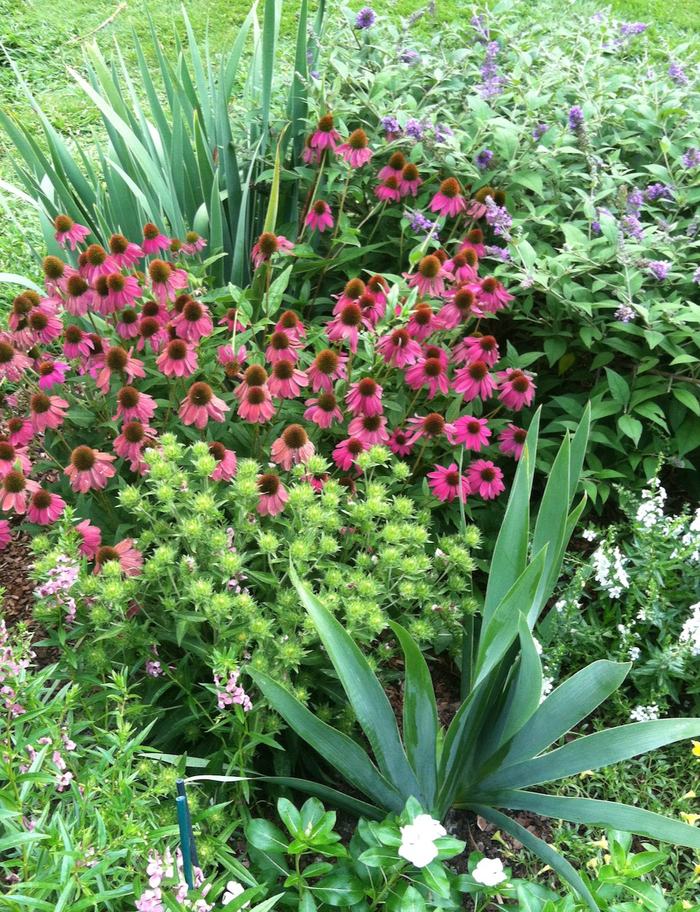
Don’t…cut back perennials and ornamental grasses in the fall. This “don’t” may require an attitude adjustment for those neat-nik gardeners who like to keep things tidy in the garden. There are several benefits of not cutting back perennials and ornamental grasses. Some perennials such as various salvias and lantana are more winter hardy when not cut back until spring. Winter cold and wet weather will often kill these perennials if their stems are removed in the fall. Ornamental grasses are still attractive elements in the garden in winter, and they are often home to solitary native bees such as mason bees which use the hollow stems to over winter. Ideally, cut them back in spring when daytime temperatures are in the upper 50s and night temperatures are no longer freezing, allowing time for the bees to emerge from winter dormancy. Birds will shelter and feed in the protection of ornamental grasses as well.
Don’t…bag or remove autumn leaves. This is another tough one for people who like a neat and clean yard. Leaving fallen tree and shrub leaves has multiple benefits. Fall leaves break down over time, adding organic matter and nutrients which are really helpful to our sandy soil. Many insect pupae and cocoons, such as the Polyphemus moth, are protected in fallen leaves, and leaf litter is important habitat for small creatures like toads, insects, etc. When possible, just rake the leaves off the lawn and into a garden bed, under trees and shrubs, without chopping them up (a frequent recommendation). Mowing or chopping leaves may destroy the insects that are hiding there.
Sometimes, what NOT to do is the best thing to do in the garden! For more information about landscape gardening, contact N.C. Cooperative Extension, Richmond County Center at 910-997-8255. Follow us on Facebook and visit our website.